You get a message. It has one strange word, a pile of letters, or just a lonely dot. Your stomach drops a little. 😬
Now you are staring at your screen. You want to know what it really means before you reply.
If you have ever typed what does mean in a text response into Google, you are not alone. Millions of people do the same thing every day. Texting moves fast, and the rules change even faster.
The good news? You can decode almost any message in under a minute. ✅
In this guide, you will learn how to read short replies, slang, and mystery symbols. You will also see real examples, a handy comparison table, and simple tips. That way, you will never send the wrong reply again.
Let’s clear up the confusion. 🔥
What Does ___ Mean in a Text Response?
When people ask what does mean in a text response, they want to know what a short word, abbreviation, or symbol stands for inside a chat message.
In most cases, it is a quick shortcut for a longer phrase. It saves time, adds tone, or shows how the sender feels.
For example, “idk” means “I don’t know.” Likewise, “brb” means “be right back.” Both are easy once you know the code.
However, some terms have more than one meaning. The same letters can be friendly in one chat and rude in another. So the meaning always depends on who sent it, where they sent it, and what came before it.
The Quick Answer
- ✅ It is a shortcut for a longer phrase.
- ✅ It often shows tone, such as joking, annoyed, or sweet.
- ✅ It changes with context, so always read the whole chat.
The Simple Meaning in Easy Words
Think of texting like talking, but without a face or a voice. You cannot see a smile. You cannot hear a sigh.
So people add small signals to fill the gap. Those signals might be letters, emojis, punctuation, or slang. Together, they tell you how to read the message.
Here is a simple way to remember it:
- Words tell you what the person says.
- Symbols and slang tell you how they feel.
- Context tells you which meaning is right.
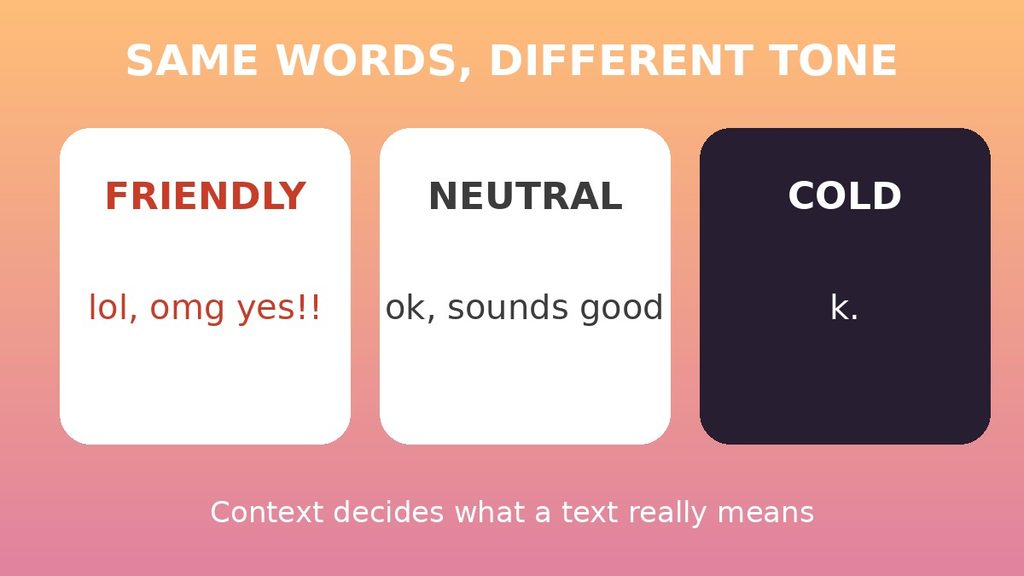
Imagine a friend texts, “fine.” That one word can mean “I’m okay” or “I’m upset.” The word did not change. The mood behind it did.
That is why a single term can leave you guessing. It is also why learning the basics pays off so fast. 💡
Where Is It Used?
You will see these short replies almost everywhere. Some places use them more than others.
Private Text Messages
This is the most common spot. Friends, family, and partners use shortcuts all day. A quick “omw” beats typing “I’m on my way.”
Social Media Chats
Instagram DMs, Snapchat, TikTok comments, and WhatsApp are full of slang. Trends here move quickly. A term that is popular this month may feel old by next month.
Group Chats
Groups love inside jokes. As a result, a word may mean something special only to that group. If you join late, you may feel lost. That is normal.
Work Messaging Apps
Slack and Teams chats also use short replies. Still, the style is calmer. You will see “np,” “fyi,” and “eta” far more than wild slang. ⚠️
Online Games
Gamers type fast, so they use even shorter codes. For instance, “gg” means “good game,” and “afk” means “away from keyboard.”
Why Do People Use It?
People do not use shortcuts to confuse you. Usually, they have a simple reason. Let’s look at the main ones.
1. Speed ⚡
Typing on a phone is slow. Short replies save time, especially when you are busy or walking.
2. Tone and Emotion ❤️
A plain “okay” can feel flat. But “okayyy 😊” feels warm. Small changes add feeling to the message.
3. Belonging 👥
Slang makes people feel part of a group. When you use the same words as your friends, you feel closer.
4. Humor 😂
Many shortcuts are jokes. Over time, they stick, and everyone starts using them.
5. Avoiding Awkward Talk 😅
Sometimes a short reply is a soft way to say “no” or “not now.” It feels easier than a long explanation.
Why Text Messages Are So Easy to Misread
Have you ever argued with someone over a text that was never meant to be mean? Most of us have. There is a good reason for it.
In real life, you read much more than words. You notice a face, a voice, and body language. Text removes all of that. So your brain tries to fill the gaps on its own.
Sadly, the brain often fills those gaps with worry. If you are already stressed, a short reply can feel like a slap. If you are happy, the same reply may feel fine.
A Quick Story
Imagine Mia texts her friend Zara, “Want to hang out later?” Zara replies, “k.” Mia spends an hour wondering if she did something wrong.
Later, she finds out Zara was just carrying groceries and typing with one thumb. Nothing was wrong at all. 😅
The lesson is clear. Before you decide how someone feels, think about what they might be doing. Then ask a kind question if you are still unsure.
Real-Life Examples With Clear Explanations
Now for the fun part. Below are common terms you may see, along with what they usually mean. Remember, tone and context still matter.
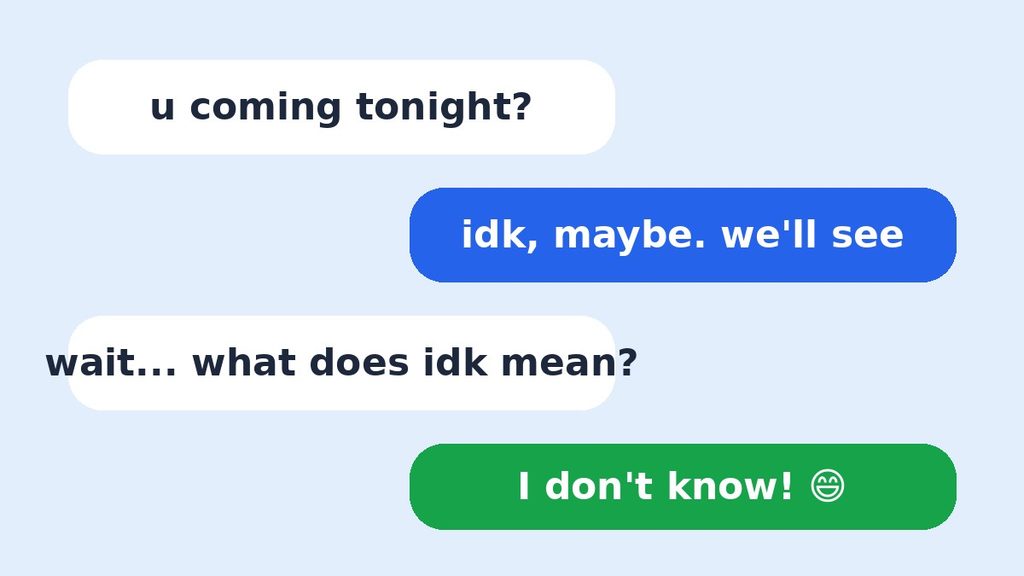
Example 1: “idk”
“Are you coming tonight?” → “idk, maybe.”
Meaning: “I don’t know.” The person is unsure. They may also want more time to decide.
How to reply: Give them space. You could say, “No worries, just tell me later.”
Example 2: “k” or “k.”
“We need to talk about dinner plans.” → “k.”
Meaning: This is “okay,” but the short form can feel cold. With a period, it often sounds annoyed or done with the topic.
How to reply: Check in kindly. Try, “Everything good?” Do not assume the worst, though. Some people just type fast. 🙂
Example 3: “ngl”
“ngl, that movie was kind of boring.”
Meaning: “Not gonna lie.” The person is about to be honest.
How to reply: Treat it as an honest opinion. You can agree or share your own view.
Example 4: “fr”
“This homework is so hard.” → “fr.”
Meaning: “For real.” It shows agreement. It says, “Yes, I feel the same.”
How to reply: Keep the vibe going. For example, “Ugh, same. Want to study together?”
Example 5: “smh”
“He forgot his own birthday, smh.”
Meaning: “Shaking my head.” The sender is disappointed or amused.
How to reply: Match the mood. A simple “lol, classic” works well. 😄
Example 6: “…” (Three Dots)
“So you’re not coming?” → “…”
Meaning: This one is tricky. It can show hesitation, sadness, shock, or annoyance. Sometimes the person is simply thinking.
How to reply: Ask gently. “Hey, did I say something wrong?” is a safe choice.
Example 7: “lol”
“I tripped in front of everyone, lol.”
Meaning: “Laughing out loud.” Today, however, it often works as a soft filler. People use it to keep the mood light, even when nothing is truly funny.
How to reply: Respond to the story, not the “lol.” Ask what happened next. 😆
Example 8: “bet”
“Pizza at 7?” → “bet.”
Meaning: “Okay, sounds good.” It is a casual way to say yes. In some chats, it can also mean “challenge accepted.”
How to reply: Simply confirm. “Great, see you then!” does the job. 🍕
Example 9: “no cap”
“That test was the hardest ever, no cap.”
Meaning: “No lie.” The sender wants you to know they are serious. In contrast, “cap” alone means someone is lying.
How to reply: Show you believe them. Try, “Wow, I believe you. How did it go?”
Example 10: “tbh”
“tbh, I’m kind of nervous about tomorrow.”
Meaning: “To be honest.” This one often comes before a real feeling. Therefore, it is a good moment to be kind. ❤️
How to reply: Offer support first. Ask what is worrying them, and listen.
Example 11: The Skull Emoji 💀
“I just sent my boss a meme by mistake 💀”
Meaning: This does not mean anything dark. Instead, it means “I’m dead from laughing” or “this is so embarrassing.”
How to reply: Laugh with them. For example, “No way! What did he say?” 😂
Mean in a Text Response vs. Similar Terms
Many people mix up abbreviations, slang, and emojis. They are related, but they are not the same. This table makes the difference easy to see.
| Type | What It Is | Example | Main Job |
|---|---|---|---|
| Abbreviation | A shortened version of a phrase | idk, brb, omw | Save time |
| Slang | Casual words that change often | no cap, slay, mid | Show style and belonging |
| Emoji | A small picture that shows feeling | 😂 🙄 😢 | Add emotion |
| Punctuation | Dots and marks that change tone | “ok.” or “ok!!” | Signal mood |
| Inside joke | A phrase only one group understands | A nickname or code word | Build closeness |
So when you ask what something means, first decide which type you are seeing. That step alone solves half the mystery. ✅
Quick Cheat Sheet of Common Text Terms
Save this list for the next time a message leaves you stuck. 📌
- omw = on my way
- brb = be right back
- np = no problem
- tbh = to be honest
- imo = in my opinion
- jk = just kidding
- ily = I love you
- ttyl = talk to you later
- rn = right now
- nvm = never mind
Keep in mind, though, that these meanings can shift. A shortcut like “nvm” may sound calm in one chat and upset in another. So always read the mood too.
When Should You Use It?
Short replies are great, but only in the right place. Here is a quick guide.
✅ Good Times to Use Shortcuts
- Chatting with close friends
- Making quick plans
- Replying when you are busy
- Joking in a group chat
⚠️ Times to Skip Them
- Writing to a boss or client
- Sending an apology or serious message
- Talking with older relatives who may not know the slang
- Sharing sad or sensitive news
A good rule is simple: if the topic matters, use full words. Clear writing shows respect. 🤝
A Simple Example Pair
Compare these two messages. Both say the same thing, but they land very differently.
- To a friend: “omw, brb in 5 😄”
- To a client: “I’m on my way and will be there in five minutes.”
The first one feels relaxed and warm. The second feels clear and professional. Choosing the right style shows you understand your reader. 👏
How Punctuation and Emojis Change the Meaning
Often, the biggest clue is not the word itself. It is the tiny detail added to it. Here is how small changes shift the mood.
Periods, Dots, and Exclamation Marks
- “Okay” feels neutral and calm.
- “Okay.” can feel serious, flat, or annoyed.
- “Okay!” feels friendly and upbeat.
- “Okay…” often shows doubt or worry.
Emojis That Flip the Message
- 🙂 can look polite, but sometimes it hides annoyance.
- 🙄 usually shows frustration or sarcasm.
- 😂 shows real laughter, so it often softens a message.
- 👍 means “got it,” though some people read it as cold.
Capital Letters and Repeated Letters
ALL CAPS often shows excitement or anger. On the other hand, repeated letters, like “sooo” or “pleaseee,” add warmth or drama. So, look at how the person writes before you decide how they feel.
Common Misunderstandings
Text messages cause more mix-ups than almost any other form of talk. Let’s bust the biggest myths.
Myth 1: “A short reply means they’re angry.”
Not always. Many people write short because they are busy, tired, or typing with one hand. Therefore, check their usual style before you panic.
Myth 2: “Every term has one fixed meaning.”
This is false. For instance, “bet” can mean “okay,” “challenge accepted,” or “I agree.” The meaning depends on the chat.
Myth 3: “Everyone uses slang the same way.”
In reality, age, country, and friend group all change the meaning. A teen in one place may use a word very differently from an adult in another.
Myth 4: “Punctuation doesn’t matter.”
It matters a lot. “Sure.” feels different from “Sure!” Also, a full stop at the end of a short reply can sound serious. ⚠️
Myth 5: “If I don’t know a term, I should just guess.”
Guessing can lead to awkward moments. Instead, take ten seconds to check. It is better to ask than to reply the wrong way.
Pro Tips for Reading Any Text Response
These simple habits will help you decode almost anything. 🚀
Tip 1: Read the Whole Chat
Do not judge a single message alone. Scroll up and read what came before. Often, the answer is already there.
Tip 2: Look at the Sender’s Normal Style
Some people always write short. Others use lots of emojis. Compare the message to how they usually text. A change in style is the real clue.
Tip 3: Use a Simple 4-Step Check
- Spot the term. Is it a letter code, slang, or a symbol?
- Check the context. What was the chat about?
- Think about the sender. How do they usually write?
- Search or ask. If you are still unsure, look it up or ask politely.
Tip 4: Ask Without Feeling Silly
Nobody knows every term. A friendly “Wait, what does that mean?” is perfectly fine. In fact, most people like to explain.
Tip 5: Match Their Energy, Not Their Slang
You do not need to copy every word. Instead, match the mood. If they are casual, relax a little. If they are serious, stay clear and kind.
Tip 6: Check the Date of the Slang
Trends fade quickly. So, if you use an old term, you may sound out of touch. When in doubt, use plain words. They never go out of style.
Tip 7: Be Careful With Sarcasm
Sarcasm is hard to read in text. A message that looks mean may be a joke. Look for hints like “lol,” “jk,” or a laughing emoji before you react. 😉
Final Thoughts
Now you know what to do next time you wonder what does mean in a text response. You look at the term, read the context, and think about the sender.
Most of the time, the meaning is simple. And when it is not, a quick question clears things up.
Texting is about connection, not perfection. So stay curious, stay kind, and do not stress over every dot. 💬❤️
FAQ: What Does Mean in a Text Response?
What does “idk” mean in a text response?
It means “I don’t know.” People use it when they are unsure, or when they do not want to give a firm answer yet.
Why do some text replies feel so cold?
Short replies lack tone. As a result, readers fill in the feeling themselves. Often, the sender is just busy. If it bothers you, ask kindly instead of guessing.
Is it rude to ask what a text term means?
Not at all. Slang changes constantly, so almost everyone gets confused sometimes. Asking shows you care about understanding.
How can I learn new texting slang quickly?
First, pay attention to the chats you are in. Next, look up new words in a trusted slang guide. Finally, use them only when you feel sure about the meaning.
Does the same term mean the same thing everywhere?
No. Meanings change with age, country, and friend group. A word may sound friendly in one chat and rude in another. Therefore, always check the context before you reply.