You send a quick 👍 to a coworker. A minute later, the reply feels cold. Did one tiny picture just cause a problem? 😬
It happens more often than you think. In fact, emojis look simple, yet their meaning changes with the person, the app, and even the year.
For example, a skull can mean “this is hilarious.” Likewise, a smile can sound polite or annoyed. Even a cap can mean someone is lying.
First, in this guide, you will learn what emojis really mean in texting. You will also see real examples, common mistakes, and simple tips to keep your messages clear. ✅
What Does Emoji Mean in Texting?
In texting, an emoji is a small picture that shows emotion, tone, or an idea in place of words. People add emojis to messages to make their feelings clear, since plain text cannot show a smile or a sigh.
The word “emoji” comes from Japanese. It combines “e” (picture) and “moji” (character). So, an emoji is, quite literally, a picture character.
However, the meaning of an emoji in texting is not always the same as its official name. For example, the official name of 💀 is “skull.” In a chat, though, it usually means “I’m laughing so hard I could die.”
The Simple Meaning in Easy Words
In simple terms, think of an emoji as a facial expression for your text. Normally, when you talk face to face, your eyes and voice show how you feel. Text has none of that.
So emojis fill the gap. Because of this, they tell the reader, “I’m joking,” “I’m happy,” or “I’m a little annoyed.”
Two things shape the meaning of any emoji:
- The official meaning: what the emoji picture shows.
- The slang meaning: what people actually use it for in chats.
In most cases, confusion happens when those two meanings do not match. That is why a quick guide helps.
Where Are Emojis Used?
Emojis appear almost everywhere people type. However, each place has its own habits.
- Text messages and iMessage: Quick, personal chats with friends and family.
- WhatsApp and Messenger: Groups, voice-note replies, and everyday updates.
- Instagram and Snapchat: Replies to stories, reactions, and playful banter.
- TikTok and YouTube comments: Short jokes, slang, and trending reactions.
- Work apps such as Slack and Teams: Light feedback, like a ✅ for “done” or a 🙏 for “thanks.”
Besides, the same emoji can look a bit different on each phone. For instance, Apple, Google, and Samsung all draw their own versions. Because of this, a face may look friendlier on one device than on another.
Why Do People Use Emojis in Texting?
People use emojis for several clear reasons. Therefore, understanding them helps you read messages more fairly.
1. To Add Tone
For instance, the sentence “Fine.” can sound angry. “Fine 🙂” or “Fine 😊” sounds softer. An emoji tells the reader how to hear your words.
2. To Save Time
One emoji can replace a whole sentence. For example, a 🎉 says “congratulations, that is great news” in a single tap.
3. To Build Closeness
Friendly emojis make a chat feel warm. In addition, research on digital communication often links emojis with a friendlier impression, as long as the emoji fits the situation.
4. To Soften Hard Messages
“I can’t make it tonight 😅” sounds kinder than the same words alone. For this reason, many people add an emoji to turn down a plan.
5. To Show Group Identity
Slang emojis, like 🧢 or 💀, work as an inside language. As a result, using them correctly shows you know how a group talks.
Emoji Meanings in Texting With Real Examples
Now for the main part. Below, you will find 20 popular emojis, grouped by how people use them. Each one comes with a plain meaning and a real example.
Laughing, Crying, and Pleading Emojis
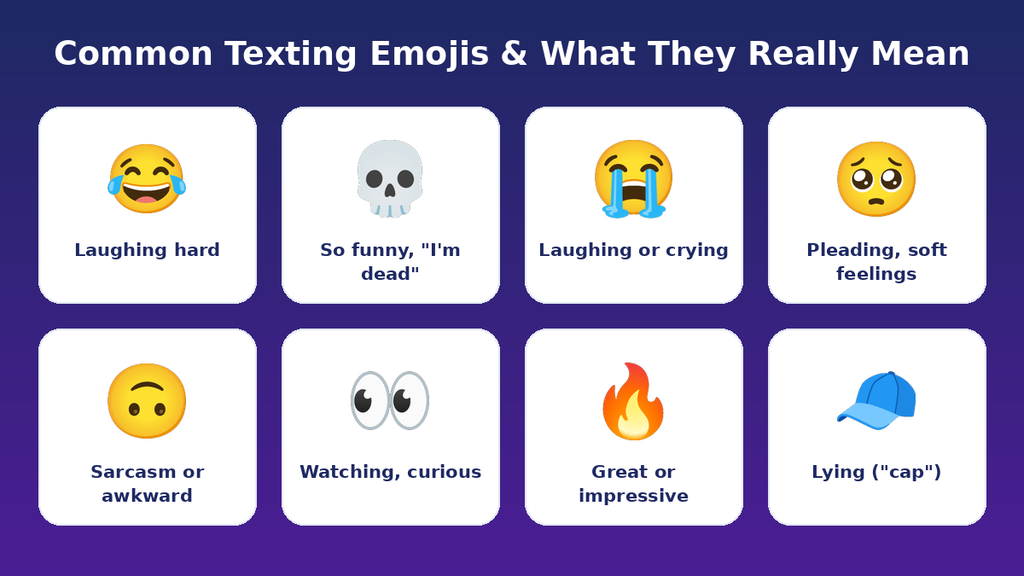
1. 😂 (Face With Tears of Joy)
Meaning: Laughing out loud.
Example: “I just fell asleep in the cab and woke up at the wrong stop 😂”
Some younger users now find it a bit old-fashioned. Even so, most people still read it as plain laughter.
2. 💀 (Skull)
Meaning: “I’m dead” from laughing, not from danger.
Example: “He said that in front of everyone 💀”
As a result, it shows that something is extremely funny or shocking.
3. 😭 (Loudly Crying Face)
Meaning: Real sadness, but often laughter or being overwhelmed in a good way.
Example: “Your puppy video made my whole day 😭”
First, check the rest of the message. Words and context will tell you which feeling is behind it.
4. 🥺 (Pleading Face)
Meaning: Begging gently, feeling touched, or asking for a favor.
Example: “Can you pick me up today? 🥺”
In other words, it works like puppy eyes in a text.
Tricky Face Emojis That Change With Tone
5. 🙂 (Slightly Smiling Face)
Meaning: A calm, polite smile.
Example: “Sure, see you at five 🙂”
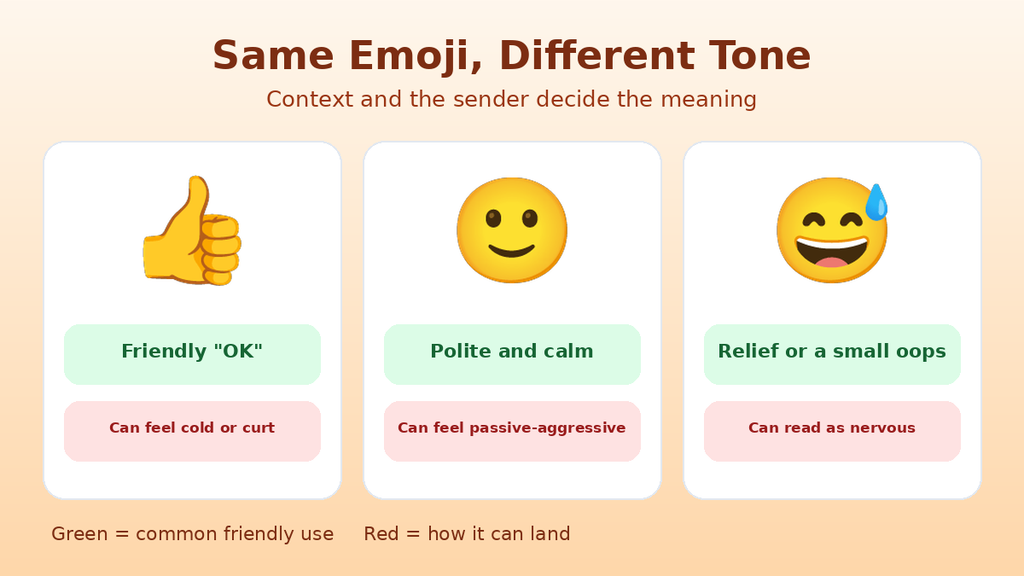
Be careful, though. After a tense message, it can sound passive-aggressive, as if someone is smiling through frustration.
6. 🙃 (Upside-Down Face)
Meaning: Sarcasm, irony, or “everything is fine” when it is not.
Example: “Monday meeting at 8 a.m. again 🙃”
Often, it hides stress behind a joke.
7. 😅 (Grinning Face With Sweat)
Meaning: Nervous relief or a small awkward moment.
Example: “I forgot my wallet at home 😅”
It says, “Oops, but it’s not a disaster.”
8. 🫠 (Melting Face)
Meaning: Embarrassment, burnout, or wanting to disappear.
Example: “I called my teacher ‘mom’ again 🫠”
Because it is a newer emoji, older users may not know it yet.
9. 🙄 (Face With Rolling Eyes)
Meaning: Annoyance, boredom, or a playful “oh, please.”
Example: “He texted ‘I told you so’ 🙄”
Among close friends, it is teasing. However, with strangers or coworkers, it can feel rude.
10. 😏 (Smirking Face)
Meaning: Smugness, teasing, or light flirting.
Example: “Guess who got the highest score 😏”
Because it can be flirty, think twice before using it in a formal chat.
Hand and Gesture Emojis
11. 👍 (Thumbs Up)
Meaning: “OK,” “got it,” or “I agree.”
Example: “Meeting moved to 3 p.m.” → “👍”
Some people feel a lone thumbs up is short or even dismissive. In certain regions, such as parts of the Middle East and West Africa, it can also be seen as rude. When unsure, add a few words.
12. 🙏 (Folded Hands)
Meaning: “Thank you,” “please,” or hope. Many people mistake it for a high five.
Example: “Thanks for covering my shift 🙏”
Overall, it is warm and polite in most chats.
13. 🫶 (Heart Hands)
Meaning: Care, support, and gratitude.
Example: “Proud of you for finishing it 🫶”
Besides, it feels softer than a plain heart.
Slang and Trend Emojis
14. 🧢 (Billed Cap)
Meaning: “Cap” is slang for lying. “No cap” means “I’m telling the truth.”
Example: “He says he ran 10 km 🧢”
Here the cap calls out a doubtful claim.
15. 🤡 (Clown Face)
Meaning: Feeling or calling someone foolish.
Example: “I trusted his promise again 🤡”
People often use it to laugh at themselves.
16. 👀 (Eyes)
Meaning: “I’m watching,” “this is interesting,” or “tell me more.”
Example: “Big announcement coming tomorrow 👀”
As a result, it builds curiosity.
17. 🔥 (Fire)
Meaning: Great, impressive, or attractive.
Example: “That presentation was 🔥”
In short, it is a quick way to give praise.
18. 💅 (Nail Polish)
Meaning: Calm confidence, or “I don’t care about the drama.”
Example: “They can talk. I’m busy 💅”
It shows a relaxed, unbothered attitude.
19. 🥲 (Smiling Face With Tear)
Meaning: Bittersweet feelings. You are smiling, but a bit emotional.
Example: “My little brother graduated today 🥲”
It also fits proud, nostalgic, or “I’m okay, really” moments.
20. ✨ (Sparkles)
Meaning: Something nice, new, or magical. It can also add playful or sarcastic emphasis.
Example: “Started my new job today ✨”
Some people also use it around a word, like “✨ productive ✨,” to tease.
Emoji Combinations and What They Say
Emojis rarely travel alone. Therefore, people often stack them to build a feeling that one emoji cannot show. Here are some combinations you will see often.
- 😂😭: “This is so funny that I’m crying.” It is a stronger version of plain laughter.
- 💀💀💀: A repeated skull raises the volume. Three skulls usually mean a joke hit extremely hard.
- 👀🔥: “That looks great, and I noticed.” It often follows a new photo or a big achievement.
- 🙏✨: A hopeful request, such as “please let this work out.”
- 🥺👉👈: A shy, sweet ask. The two fingers pointing together show nervousness.
- 🙃🔥: Dry humor about a messy situation, as in “everything is on fire, but I’m fine.”
Repetition matters, too. For example, one 😂 is a light laugh. Meanwhile, five of them in a row show real excitement, but they can also feel over the top in a work chat.
Also, the order changes the story. “😭 I love it” and “I love it 😭” both show strong feelings. Still, the first one starts with the reaction, which makes it feel more dramatic.
Emoji vs Similar Terms
Many people mix up emojis with similar tools. Likewise, a few emojis look close but feel very different. These tables clear it up.
Emoji vs Emoticon vs Sticker vs GIF
| Term | What It Is | Example |
|---|---|---|
| Emoji | A small standard picture character | 😊 |
| Emoticon | A face made from keyboard symbols | 🙂 |
| Sticker | A larger picture, often drawn or branded | A cartoon character saying “Hi” |
| GIF | A short moving image | A looping reaction clip |
Laughing Emojis Compared
| Emoji | Feeling | Best For |
|---|---|---|
| 😂 | Classic laughter | Everyday jokes |
| 🤣 | Laughing so hard you roll on the floor | Very funny moments |
| 💀 | Too funny or too shocking to handle | Jokes among friends |
| 😭 | Laughing, crying, or overwhelmed | Cute or emotional moments |
As you can see, the difference is mostly about intensity and age group. Younger users often prefer 💀 and 😭, while many older users stay with 😂.
When Should You Use These Emojis?
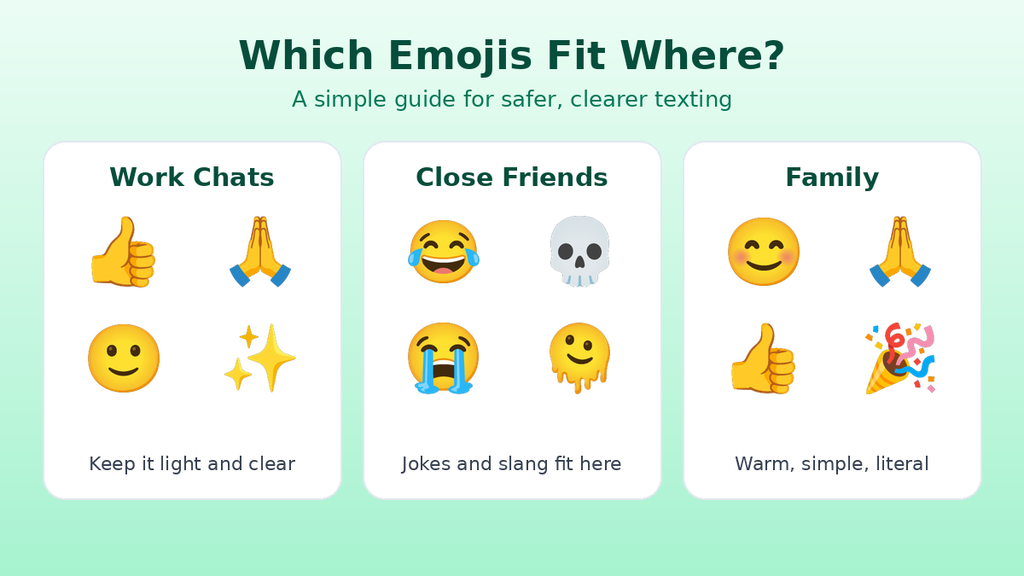
Good emoji use depends on who you are talking to. A message that works with a best friend might confuse your manager.
First, use emojis when:
- You want to soften a message, such as a polite “no.”
- You want to show warmth to a friend or relative.
- You are joking and want to make sure it lands as a joke.
- You want to react quickly without writing a full reply.
On the other hand, skip or reduce emojis when:
- You are writing a formal email or a first message to a stranger.
- The topic is serious, such as bad news or a complaint.
- You are not sure how the other person will read it.
Common Misunderstandings About Emoji Meanings
However, even careful texters get caught out. Here are the most frequent mix-ups. ⚠️
- “Every smile is happy.” Not true. A 🙂 or 🙃 can hide sarcasm or stress.
- “💀 means something dark.” In most chats it means something very funny.
- “😭 always means sadness.” It is often a reaction to something sweet or hilarious.
- “🙏 is a high five.” It is folded hands, used for thanks or a request.
- “A thumbs up is always positive.” Some readers hear it as short or cold, so context matters.
- “Everyone reads emojis the same way.” Age, culture, and even phone brand can change the meaning.
For this reason, it helps to read the emoji together with the words around it. The full message gives the best clue.
Pro Tips for Using Emojis the Right Way
These simple habits will keep your texting clear and friendly. 🔥
- Match the other person’s style. If they use few emojis, do the same.
- Use one or two, not ten. A long row of emojis can distract from your message.
- Put the emoji where the tone matters. It usually belongs at the end of a sentence.
- Add words to a thumbs up. “👍 Sounds good, thanks!” feels warmer than 👍 alone.
- Check unfamiliar emojis first. A quick search can save you from an awkward moment.
- Avoid emojis with adult meanings at work. Some fruit and vegetable emojis carry a hidden meaning in slang.
- Think about accessibility. Screen readers read each emoji’s name aloud, so too many can make a message hard to follow.
How to Figure Out an Emoji You Don’t Know
New emojis arrive every year, and slang changes even faster. So you will eventually meet one you cannot read. Don’t worry, because a short routine solves most cases. 🔍
- Read the full message. The words around an emoji usually give away its tone.
- Look at the earlier chat. A joke, a complaint, or good news often explains the emoji.
- Check the official name. Long-press the emoji on your keyboard or use your phone’s emoji search to see what it is called.
- Search “[emoji] meaning in texting.” Slang dictionaries and emoji reference sites list current uses.
- Ask kindly. A simple “Haha, what does that one mean?” works well. Most people are happy to explain.
Finally, if you still feel unsure, reply with plain words. Clear writing is never wrong.
Emoji Meanings by Age and Culture
Emoji language grows inside groups. As a result, two people can read the same emoji in two different ways.
Age Differences
Younger users often treat 😂 as dated and prefer 💀 or 😭 for laughter. On the other hand, many older users read 💀 literally and may worry about the person who sent it.
A similar gap appears with 🙂. Some younger readers hear a cold tone, while older users often mean it as a friendly smile. Neither side is wrong. In fact, they simply learned the emoji in different places.
Cultural Differences
Gestures do not travel perfectly. The thumbs up is a good example, since it is warm in many places but may feel rude in a few regions. Folded hands 🙏 can signal prayer, thanks, or a request, depending on the reader’s background.
For this reason, global teams and international friendships work best with simple emojis, such as 😊, ✅, and 🎉. When your message really matters, add a clear sentence.
What to Say When an Emoji Is Misread
Sometimes a misunderstanding still happens. In that case, a short and calm line fixes it:
- “Sorry, I meant that as a joke 😊”
- “To be clear, I’m happy with the plan.”
- “That 🙂 was meant to be friendly, not annoyed.”
Overall, a quick note like this protects the relationship and keeps the chat light.
Final Thoughts on Emoji Meaning in Texting
Emojis are tiny, yet they carry big feelings. Their meaning depends on the sender, the group, and the moment.
Once you learn the common meanings, you read messages with more confidence. Besides, you avoid sending the wrong tone by mistake.
So, the next time a message leaves you puzzled, pause and look at the context. Then, reply with an emoji that truly fits. ✅
FAQ: Emoji Meanings in Texting
What does the 💀 emoji mean in texting?
In most chats, 💀 means “I’m dead,” which is slang for laughing very hard. It does not usually point to anything dark or threatening.
Why does a 🙂 emoji sometimes feel rude?
The smile is small and controlled. After an annoying or serious message, it can sound like forced politeness. When you want to sound warm, 😊 is usually a safer choice.
What does 🧢 mean in a text?
It stands for “cap,” which is slang for a lie. If someone replies “🧢,” they do not believe you. If you say “no cap,” you are saying that you are being honest.
Do emojis mean the same thing everywhere?
No. Meanings shift by country, age group, and app. If you text someone from another culture or a different generation, keep your emojis simple and add a few words.