You get a message that ends with :/ and your stomach drops. Is your friend annoyed? Confused? Just tired?
One tiny face can change the whole tone of a text. And if you have ever stared at your screen wondering what do emoticons mean in texting, you are not alone.
This guide explains 20 of the most common text faces in plain English. You will see what each one means, when to use it, and where people get it wrong. 🔥
What Do Emoticons Mean in Texting?
Emoticons are faces made from keyboard characters, like :) or :(, that show how you feel in a text message. They add the tone of voice and facial expression that plain words cannot carry.
The word “emoticon” is a mix of “emotion” and “icon.” You read most of them sideways. Tilt your head to the left and :) becomes two eyes and a smile.
The simple meaning
Think of an emoticon as a tiny facial expression in text form.
:)says “I’m friendly” or “I’m happy.”:(says “I’m sad” or “that’s disappointing.”;)says “I’m joking” or “wink, wink.”
That is really all there is to it. The small details, like the nose or the eyes, shape the exact mood.
Where Are Text Emoticons Used?
You will spot them almost anywhere people type quickly:
- Text messages (SMS, iMessage) between friends and family
- WhatsApp, Telegram, and Messenger chats
- Discord, Reddit, and gaming chats
- Email and workplace chat, mostly the gentle ones like
:) - Comment sections and forums, where they have been around since the early days
Why Do People Use Emoticons in Texting?
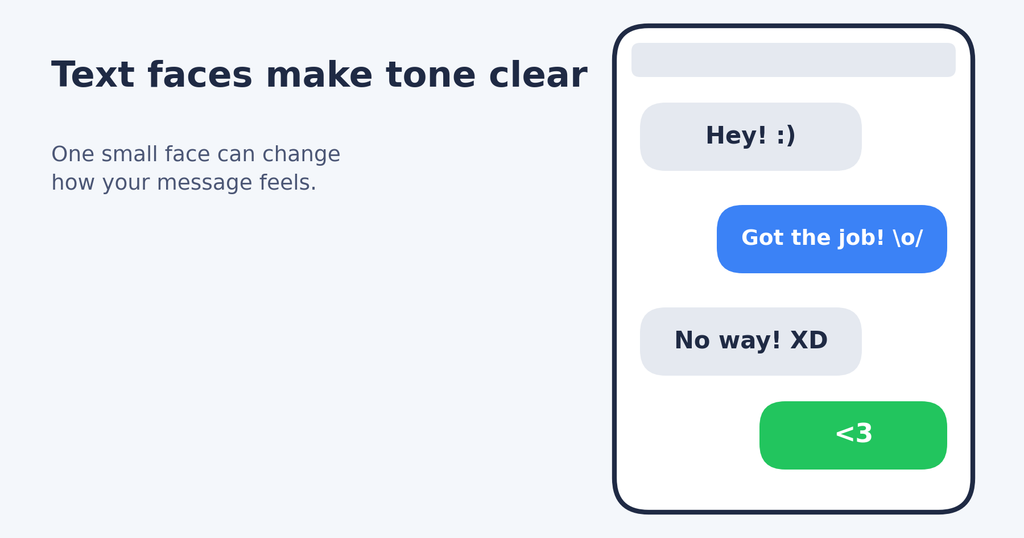
Text has one big weakness: it hides tone. “Fine.” can mean calm, cold, or furious.
Emoticons fix that in two characters. People use them to:
- Soften a message (“Can we talk later? :)”)
- Show a joke (“You’re late again ;)”)
- Express feelings fast without typing a long explanation
- Build warmth when they cannot see your face
They also feel personal. A typed face has a handmade, casual charm that many people still prefer over the ready-made pictures on their phone.
20 Common Emoticons and What They Mean
Here is the quick decoder. Tilt your head if you need to. 😊
Happy and friendly faces
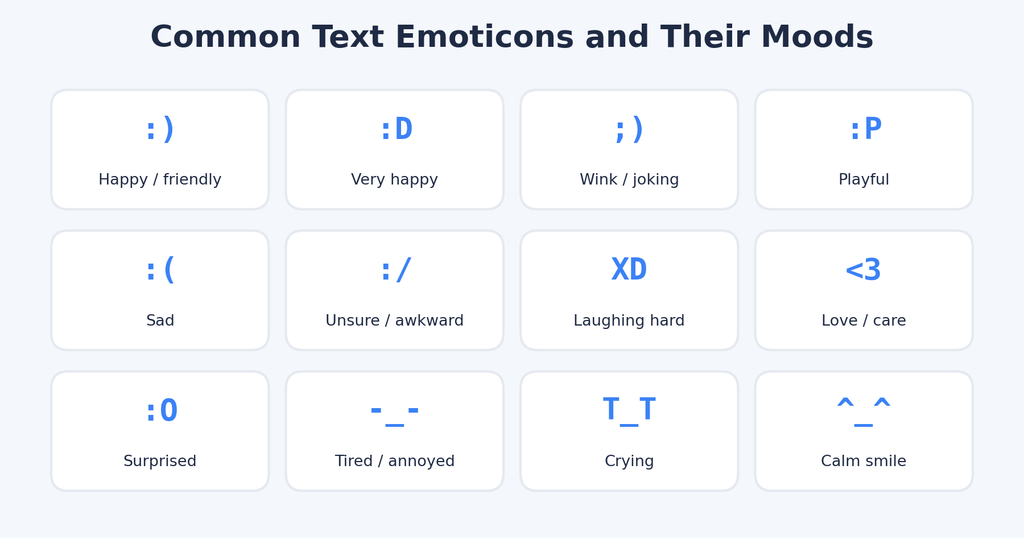
:)Happy, friendly, or polite. The safest face of all.:DVery happy, laughing, or excited. A big open grin.;)A wink. Used for jokes, teasing, or light flirting.:*A kiss. Warm and affectionate, so save it for people you are close to.<3A heart. It means love, care, or strong thanks.^_^A calm, content smile. Popular in anime fan communities.\o/Arms raised in celebration. Think “we did it!”B)Cool, with sunglasses. Often used when someone feels confident or relaxed.
Playful and silly faces
:PA tongue stuck out. Playful, teasing, or cheeky.XDLaughing so hard the eyes squeeze shut. It means “that is hilarious.”:3A cute, cat-like smile. Sweet and a little goofy.o_OOne eye wide, one narrow. Confused, suspicious, or shocked.
Sad, upset, and unsure faces
:(Sad or disappointed.:'(Crying, with a tear.T_TCrying with streaming eyes. More dramatic than:'(.:/Unsure, awkward, or mildly annoyed.:|Neutral, straight-faced, or unimpressed.>:(Angry. The eyebrows slant down in frustration.-_-Tired, bored, or annoyed. The classic “really?” face.:OSurprised or shocked, with a wide-open mouth.
Real-Life Examples of Emoticons in Texting
Seeing them in action helps. Here are five everyday chats.
Example 1: Softening a request “Could you send me the notes by tonight? :)” The smile keeps it friendly, not pushy.
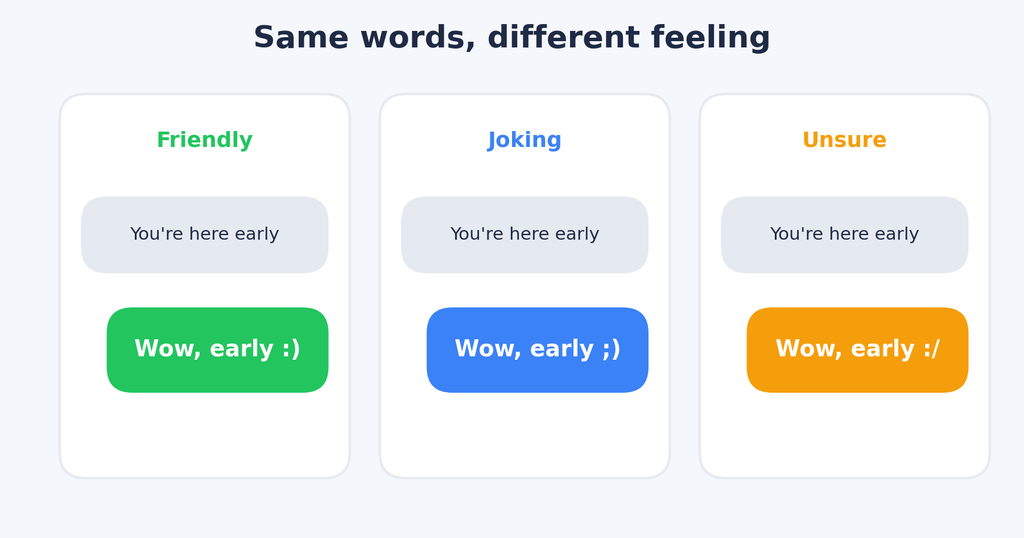
Example 2: Teasing a friend “Wow, you finally replied ;)” The wink tells your friend you are joking, not angry.
Example 3: Sharing good news “I got the job! \o/” It shows pure joy and invites a celebration.
Example 4: Showing doubt “So you want to meet at 6 a.m.? :/” Here the face says, “Are you sure about that?”
Example 5: Laughing at a joke “That meme just ruined me XD” It shows you laughed for real, not just politely.
Emoticons vs Emojis vs Text Slang
Many people mix these up. They are related but not the same. ✅
| Type | What it is | Example | Where it shines |
|---|---|---|---|
| Emoticon | A face typed with keyboard characters | :) | Quick, casual texts |
| Emoji | A small picture from a phone’s emoji menu | 😊 | Social media and modern chats |
| Text slang | Short words or letters | LOL, BRB | Fast, informal messages |
| Kaomoji | Japanese-style faces that go beyond the sideways view | (^_^) | Fans of anime and online culture |
In short, emoticons are made of letters, numbers, and symbols, while emojis are tiny images. Many phones turn :) into a smiley emoji automatically, so you may not even notice the switch.
When Should You Use Emoticons?
Good moments to use them:
- ✅ Texting friends, family, and close coworkers
- ✅ Adding warmth to a short or blunt message
- ✅ Making it clear you are joking
- ✅ Casual group chats
Moments to skip them:
- ⚠️ Formal emails or job applications
- ⚠️ Serious or sensitive topics, like bad news
- ⚠️ First messages to people you do not know well, especially flirty ones
- ⚠️ Messages to someone who may be upset with you
When you are unsure, one gentle :) is usually fine. More than that can feel like too much.
Common Misunderstandings About Text Emoticons
Even a simple face can go wrong. Here is where people trip up. ⚠️
1. :) is not always happy. Some people use it as a polite or even cold sign-off. Read it alongside the words around it.
2. :/ does not always mean anger. It often just means “hmm,” “awkward,” or “I’m not sure.”
3. ;) can be read the wrong way. A wink is playful, but some people take it as flirting. Know your audience.
4. -_- may feel rude. You might mean “I’m tired,” but the other person might read it as “you annoy me.”
5. The same face means different things across cultures. ^_^ is calm and happy in some communities, while others rarely use it at all. Age and online habits also change how people read faces.
Pro Tips for Using Emoticons Well
Small habits make a big difference. 🔥
- Match the mood of the chat. If the other person is serious, keep your faces light and few.
- Use one at a time. A single face feels natural. A whole string of them can look careless.
- Check the words first. The face should fit the message, not fight it.
- Think about the person. A coworker, a grandparent, and a best friend will all read the same face differently.
- Ask when unsure. If someone’s face confuses you, a simple “Did you mean that as a joke?” clears it up fast.
- Mind your keyboard. On some phones,
:)changes into an emoji. If you want the classic look, check your settings.
Final Thoughts
So, what do emoticons mean in texting? They are small, typed faces that bring tone and feeling into words on a screen. A smile softens a request. A wink signals a joke. A sideways frown shares a bad day.
You do not need to memorize all 20. Start with a few you like, watch how the people around you use them, and trust your instincts. Used with care, these tiny faces make your messages clearer and a lot more human. 😊
Frequently Asked Questions
What do emoticons mean in texting?
Emoticons are faces built from keyboard characters, like :) or :(, that show emotion in a text. They help the reader understand your tone, so jokes, kindness, and sadness come across clearly.
What is the difference between an emoticon and an emoji?
An emoticon is typed using letters, numbers, and symbols, such as ;). An emoji is a small picture, such as 😉, chosen from an emoji menu. They often carry the same meaning, but they look different.
What does :/ mean in a text?
It usually shows that someone feels unsure, awkward, or a little bothered. The exact meaning depends on the chat, so read the words around it.
Are emoticons still used today?
Yes. Many people still use them because they feel personal and quick to type. They are common in casual chats, gaming spaces, and online communities.